

Manufacturing large-format precast concrete panels requires more than simply having a large moulding surface. When panels exceed 17 metres in length, the challenge lies in controlling demoulding, maintaining geometry, compacting the concrete correctly and coordinating the movement of several production tables within the same plant.
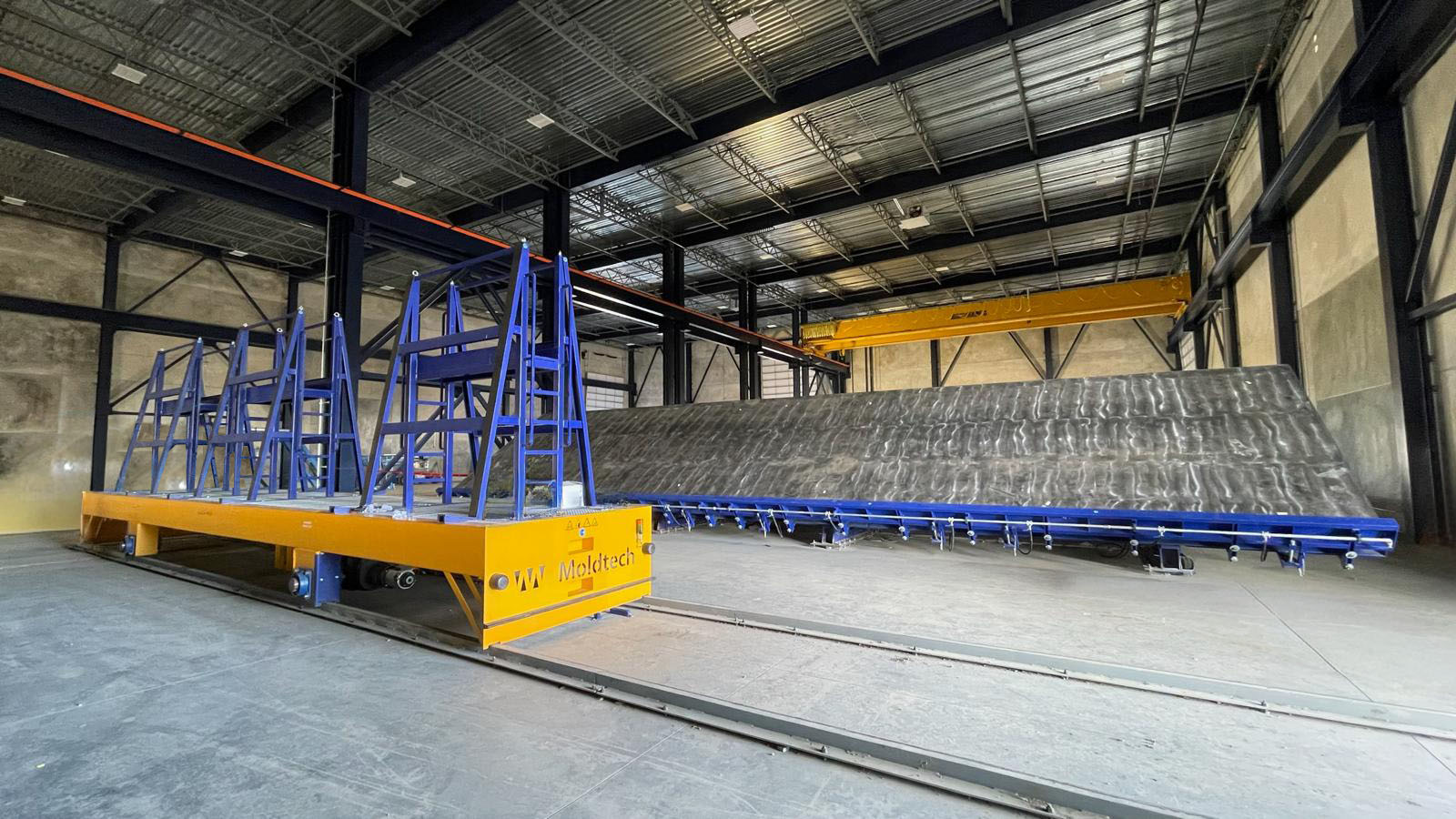
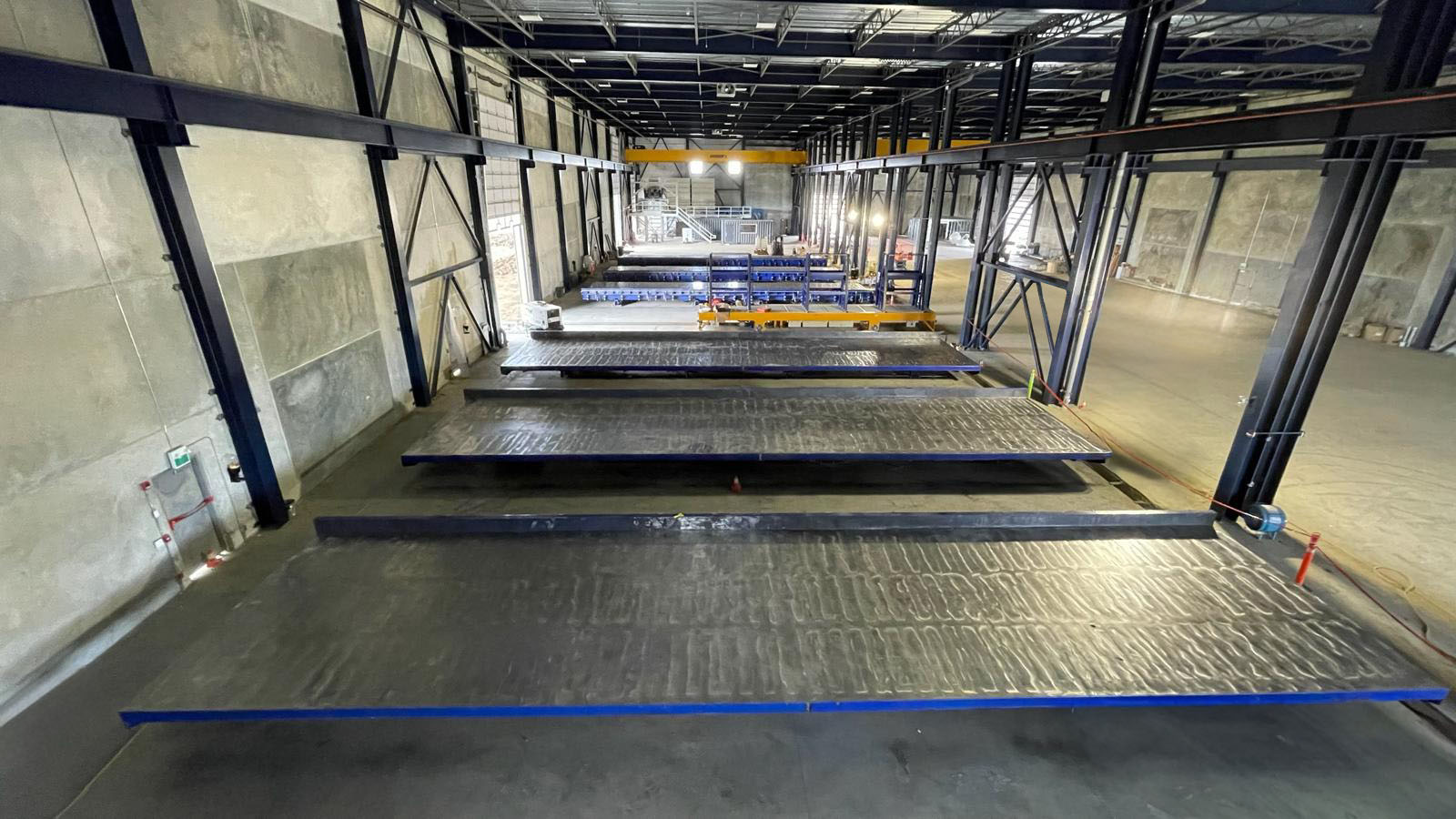
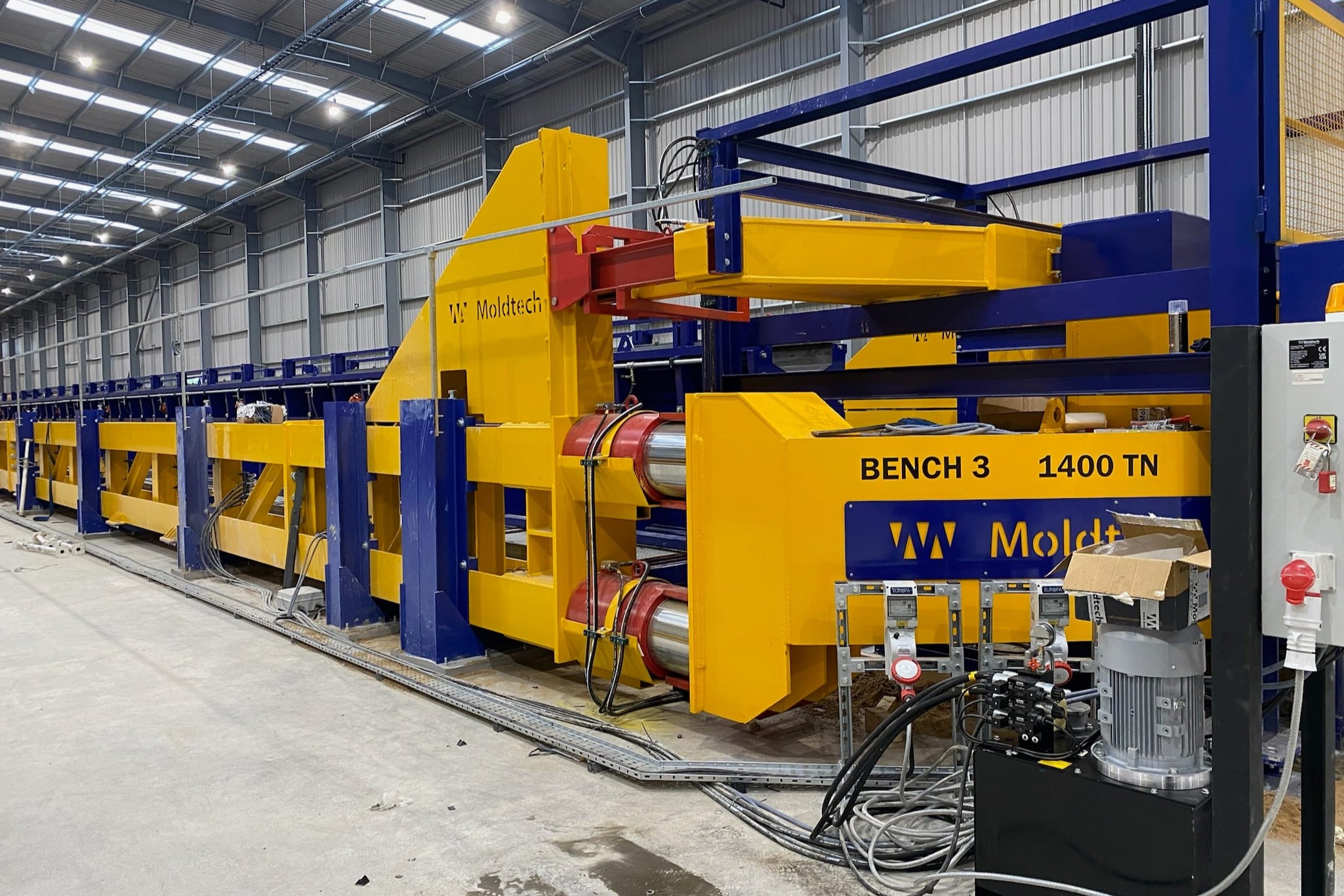
This is the approach behind the new supply developed by Moldtech for a Canadian company: six 17.3 × 4 m tilting tables conceived as a coordinated production system and operated by a single hydraulic power unit.
Six production stations, one common installation
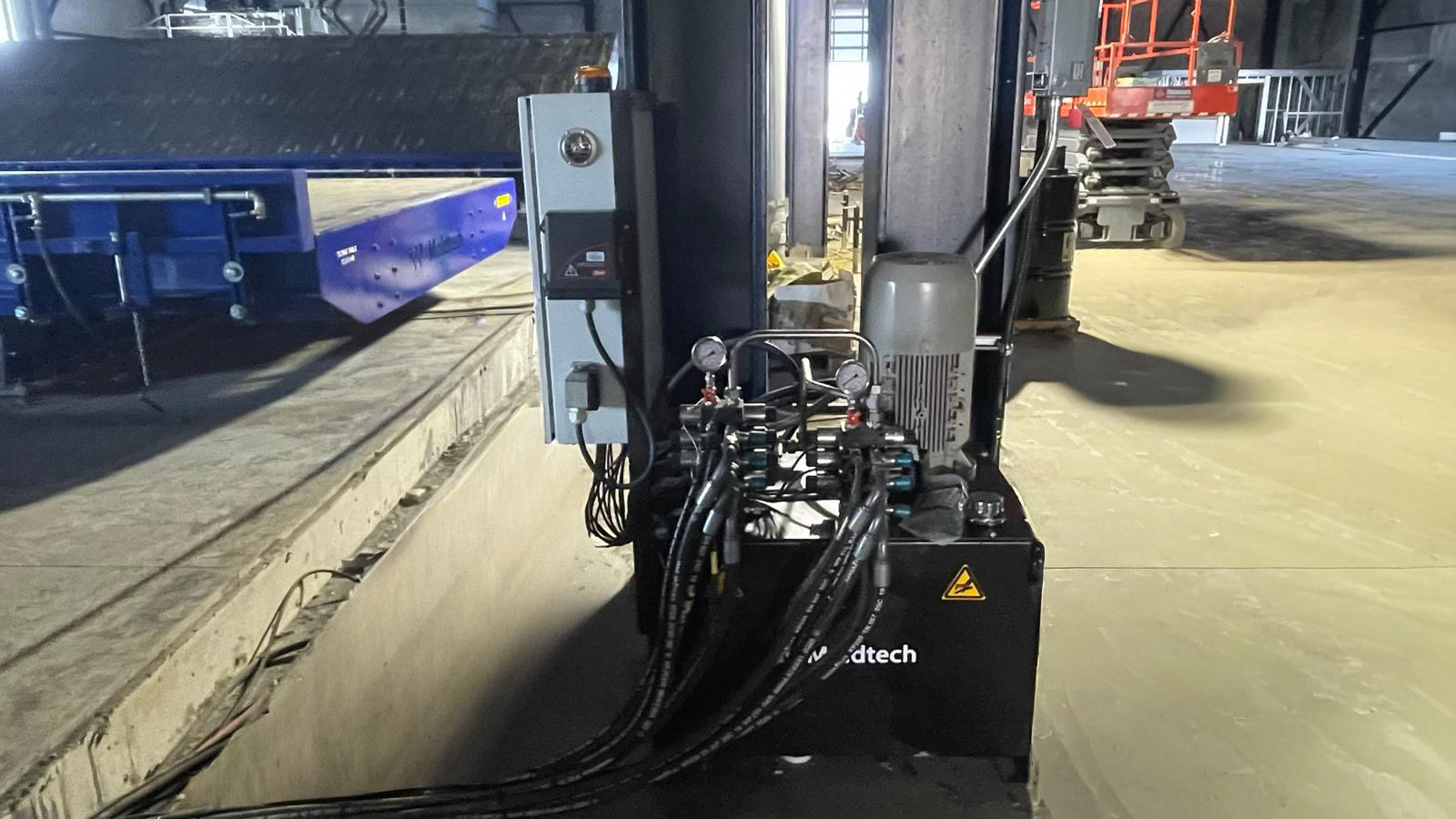
The project is not based on six independent machines simply sharing the same factory space. The tables form part of an integrated installation in which one hydraulic power unit serves all six units.
The hydraulic unit remains connected to the complete system, while the operator selects from the control panel the table to be operated. Movements are carried out alternately, with each table designed to tilt individually.
This architecture centralises one of the main functions of the installation while maintaining six independent production surfaces.
From the main control cabinet, the operator manages pump start and stop, table selection, raising and lowering movements, system reset and emergency stop. The system also includes a wireless remote control for tilting the previously selected unit.
17.3 metres of working surface for large precast panels
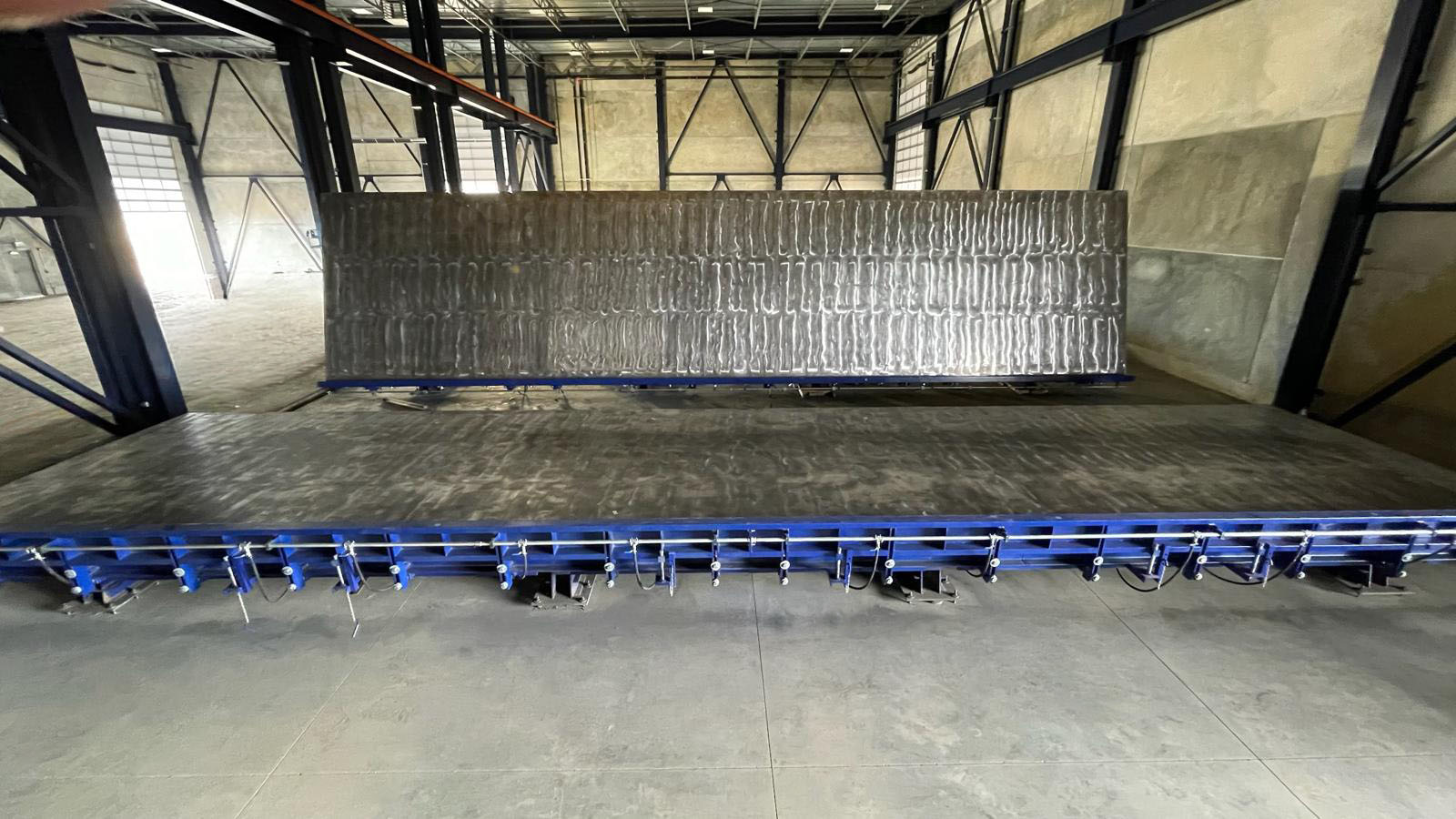
Each table is built from two modules approximately 8.65 metres long and 4 metres wide. Once assembled, they form a 17.3 × 4 m production surface.
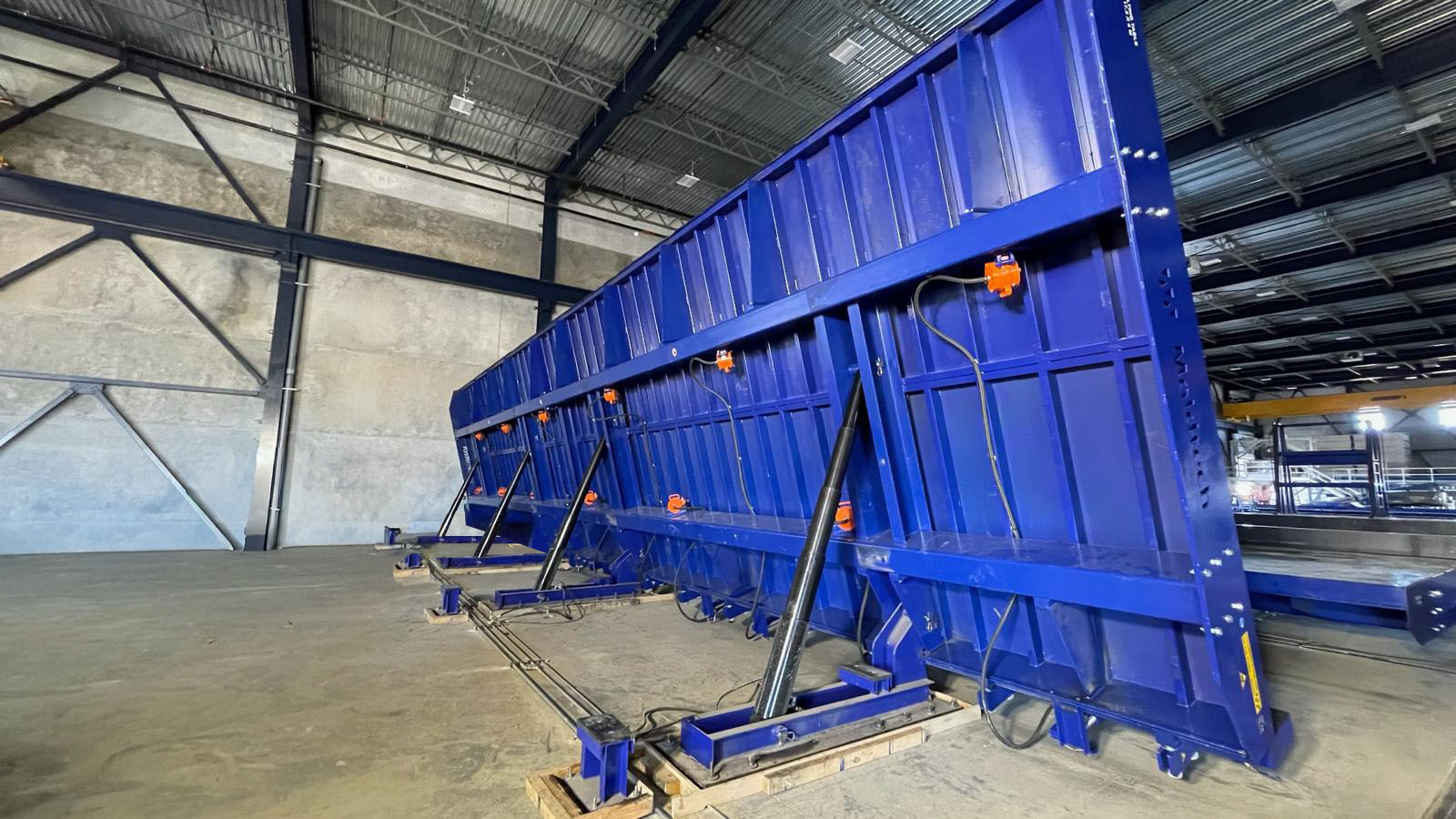
The structure consists of a fixed frame anchored to the foundation and a tilting deck capable of reaching a maximum inclination of 74°.
The tables are designed for the production of non-prestressed precast concrete panels up to 56’-9” long and 13’ high, dimensions that correspond approximately to the 17.3 × 4 m format of the installation.
One of the most relevant features of the equipment, however, is not only its size.
One table, three panel thicknesses
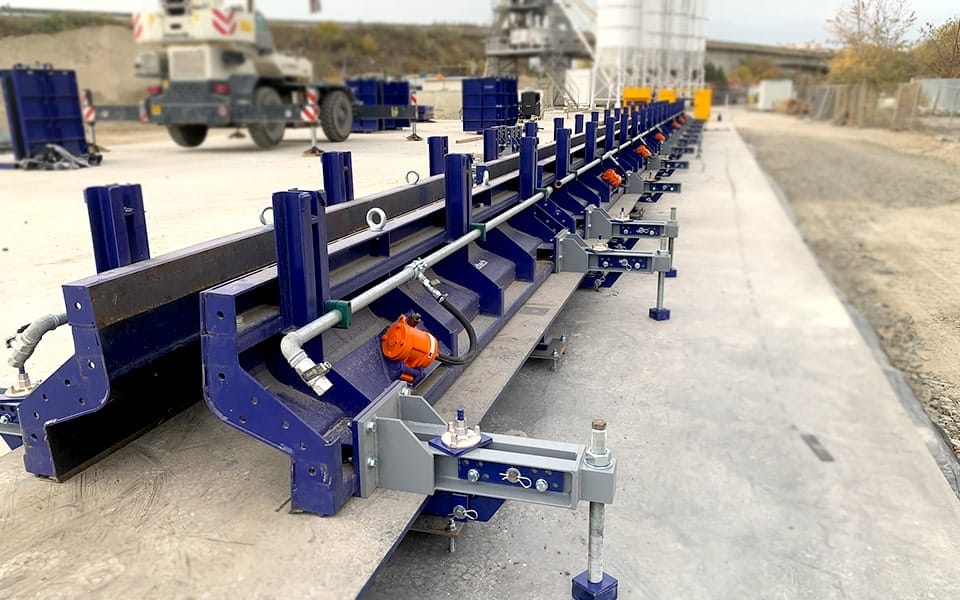
The lower longitudinal side can be vertically adjusted to modify the thickness of the panel to be produced.
Three main positions are available:
- 8” — approximately 203 mm
- 10” — approximately 254 mm
- 12” — approximately 305 mm
Adjustment is carried out mechanically and manually through a system comprising a threaded adjustment rod, height positioner and fixing and perpendicularity elements.
This solution allows the production configuration of the table to be changed without introducing unnecessary mechanical complexity. For plants working with different panel types, this flexibility broadens the range of elements that can be produced using the same equipment.
Demoulding starts with controlling 74 degrees of movement
For panels of this size, demoulding is a critical part of the production cycle.
Each table is equipped with four telescopic hydraulic cylinders, responsible for progressively lifting the deck to the required position for panel removal.
The hydraulic circuit also incorporates pilot-operated valves installed directly on the cylinders. In the event of a hose failure, power loss or another incident, these valves are designed to hold the table in position and prevent uncontrolled lowering.
The common hydraulic installation includes a 30 l/min pump and a 180-litre tank and has been specifically developed to operate the six-table system.
Twelve pneumatic vibrators beneath each table
Geometry is not the only parameter that must remain under control.
During casting, each table is equipped with 12 pneumatic vibrators distributed along the frame. Their role is to improve concrete compaction and contribute to a homogeneous mix and consistent surface finish.
The vibrators can be activated individually. This allows the vibration process to follow the progress of concrete placement, with only the required areas operating at each stage.
There is therefore a direct relationship between concrete distribution, vibration and process control.
A table does not stop when casting is finished
The design of the equipment also considers what happens once the mould has been filled.
When the concrete has reached sufficient strength for safe handling, the table is tilted and the panel can be lifted using the plant’s handling equipment.
The next stage then begins: cleaning the surface, removing concrete residue, maintaining the working deck and reapplying the release agent before the next production cycle.
This focus on the complete production cycle is particularly important in repetitive manufacturing, where the quality of the next panel begins as soon as the previous one is removed.
From demoulding to transport: a 50-tonne electric cart
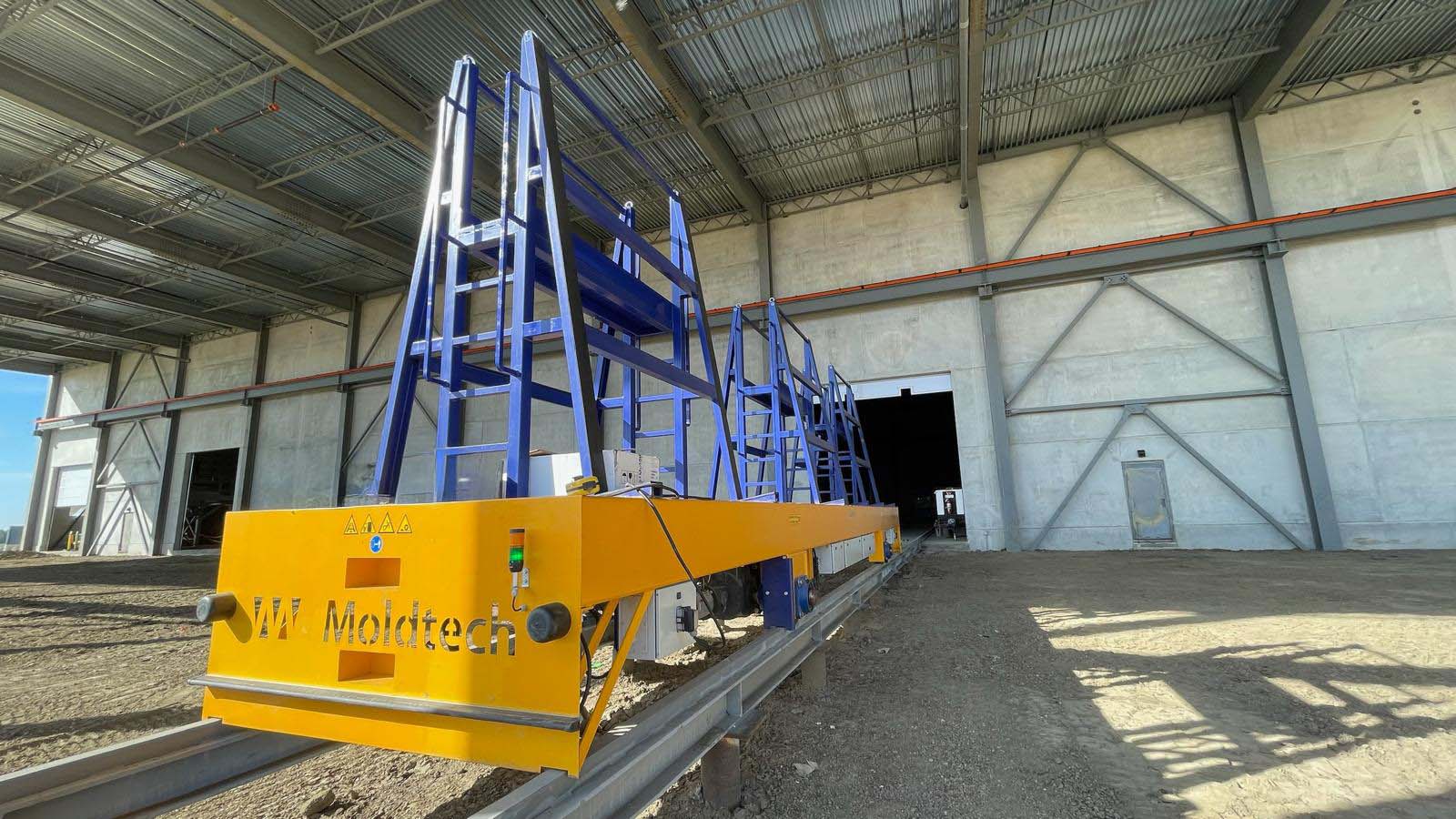
The project also includes a 50-tonne motorised electric transport cart, specifically developed to move the panels produced on the tilting tables in a vertical position.
The cart travels linearly on rails and can move in both directions, allowing the panels to be transferred from the production area to other areas of the plant once demoulding has been completed.
Its structure incorporates three support frames for the panels, together with panel protectors, platforms and integrated walkways. The technical documentation specifies that loads must be positioned as centrally as possible on the cart axes in order to maintain balanced weight distribution during transport.
The travelling system is driven by two 3 kW electric gearmotors with electromagnetic braking, transmitting movement to the drive wheels.
Power is supplied by an 80 V, 780 Ah battery with a nominal stored energy of 62.4 kWh. This allows the cart to operate without a permanent connection to the electrical grid during normal use. Grid connection is only required for battery charging through a high-frequency charger supplied at 600 V three-phase.
Controlled movement inside the plant
The cart is operated using a wired pendant control that allows forward and reverse movement, system reset and emergency stop.
To make manoeuvring easier, the equipment includes a control connection point at each end of the cart. This allows the operator to choose the position that provides the best visibility of both the equipment and the load during travel.
The system also incorporates inductive sensors to control movement along the rails. As the cart approaches the end of the track, its speed is automatically reduced before it comes to a stop at the end position.
Safety during travel is complemented by sensitive safety edges installed at the ends of the cart, designed to interrupt movement in the event of contact with a person or obstacle, together with visual and audible beacons indicating operating status, movement or machine fault.
The incorporation of this transport cart extends the scope of the project beyond the production stage itself. Once the panel has been demoulded, the system also integrates internal handling using equipment specifically designed for large-format elements weighing up to 50 tonnes.
Manufactured in Spain for production in Canada
The six tilting tables and the transport cart have been designed and manufactured by Moldtech in Spain as part of a specific solution for a precast concrete facility in Canada.
Rather than a simple group of tilting surfaces, the project forms a coordinated production system in which steel structure, hydraulics, geometric adjustment, vibration, control and internal transport work together.
Projects of this type show where engineering for precast production becomes especially relevant: the objective is not only to manufacture a mould capable of containing concrete, but to define how a panel of more than 17 metres is prepared, cast, compacted, demoulded, transported and returned into the next production cycle.
With this new supply, Moldtech continues to apply its international experience as a manufacturer of moulds and equipment for the precast concrete industry, developing in Spain production systems adapted to the real operating requirements of plants in different markets.