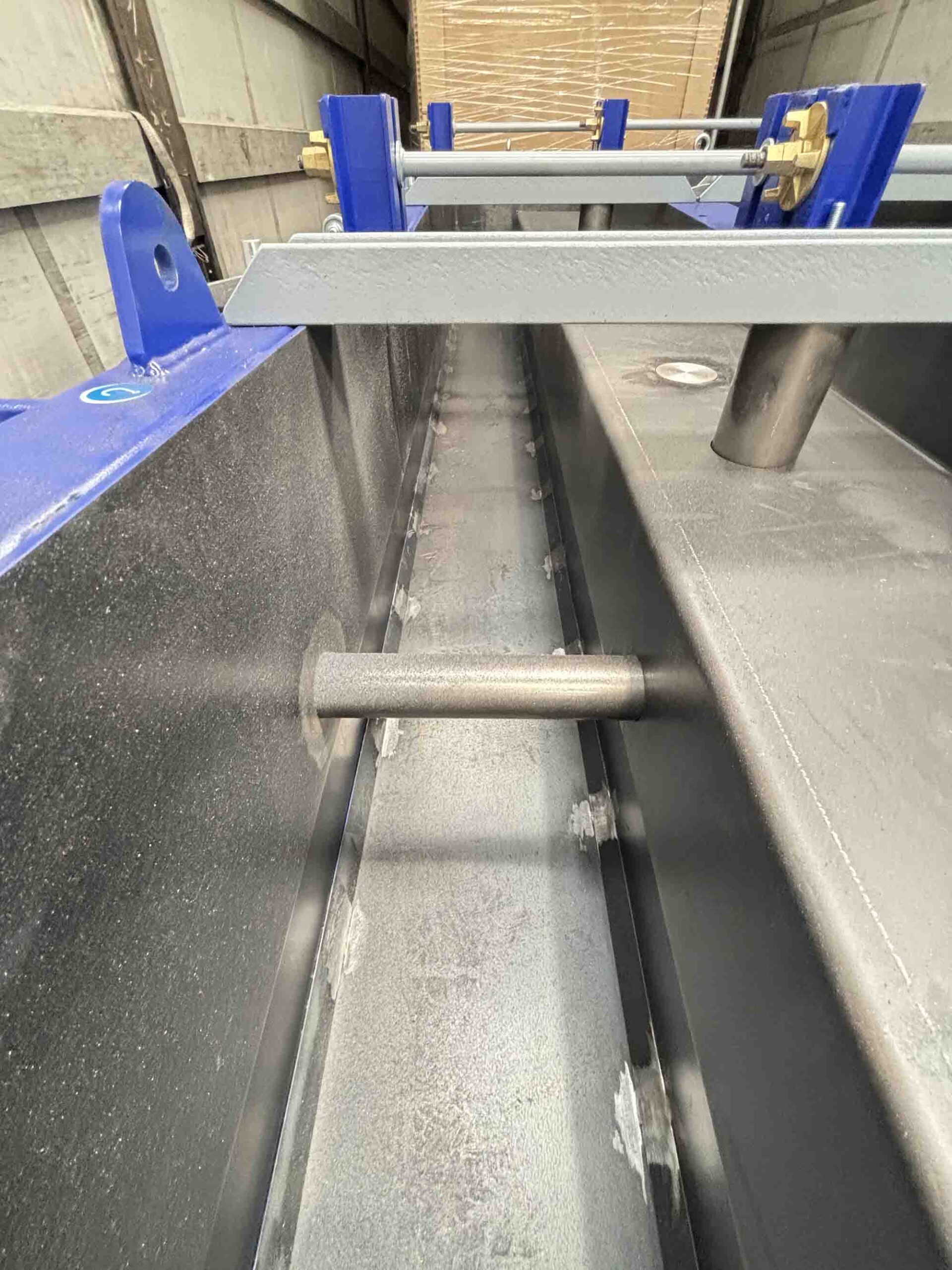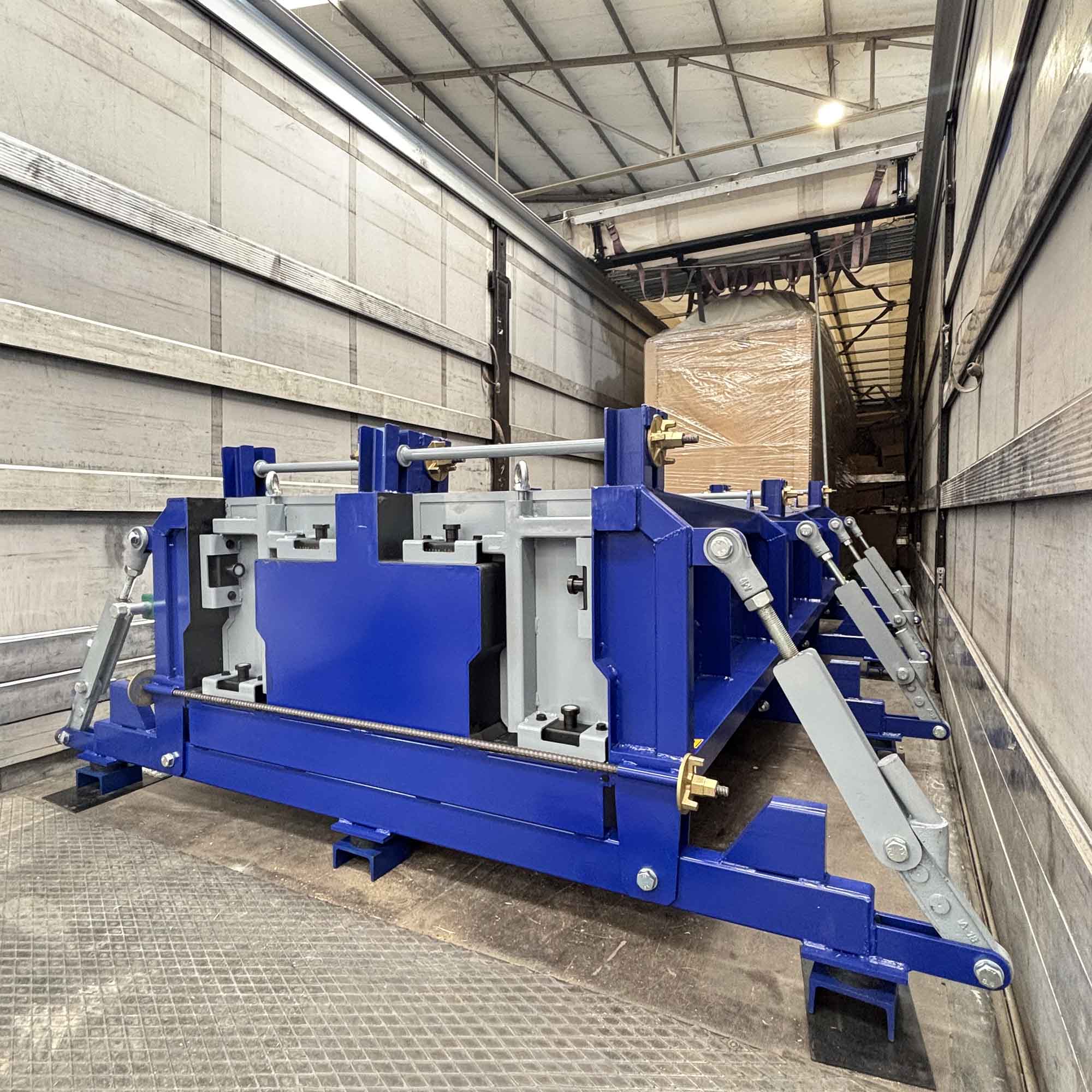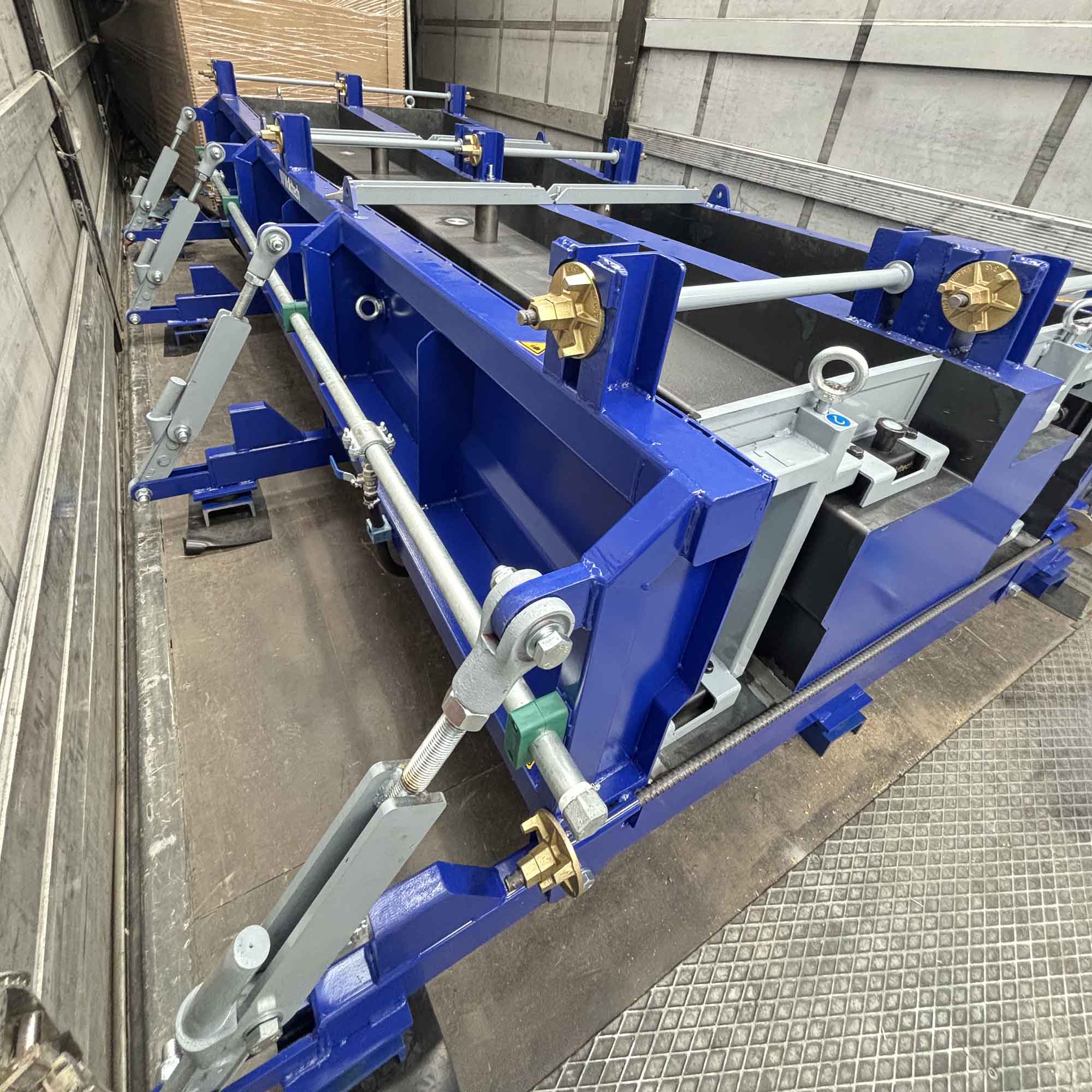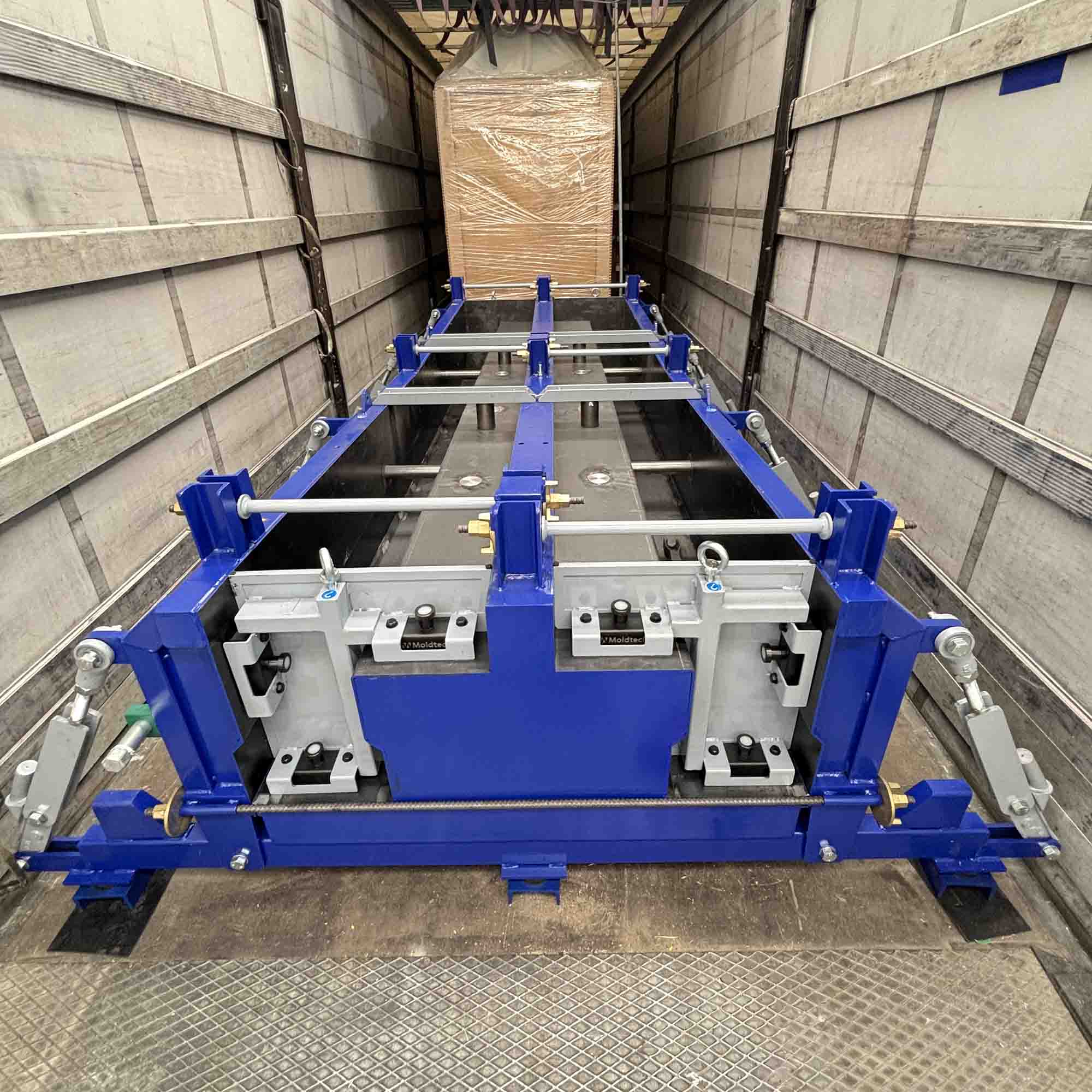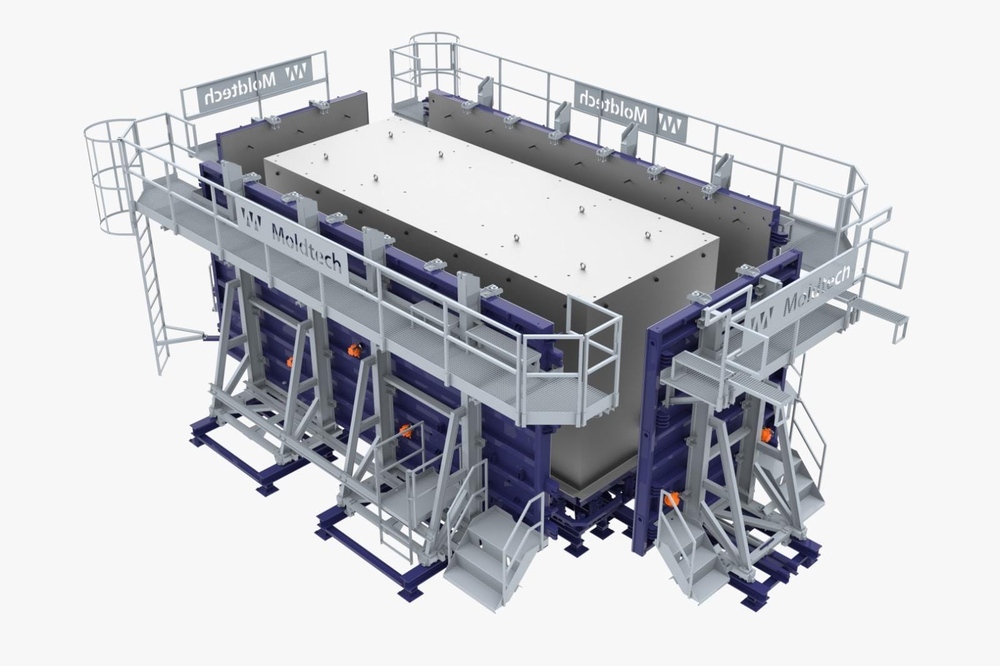


Moldtech has developed an Inverted Timpan Mould for a project in Romania, available in T1, T2 and T3 configurations and designed for the industrial production of non-prestressed precast concrete elements. The solution combines a dedicated steel structure, opening and closing systems, magnetic fixing and pneumatic vibration, resulting in equipment focused on repeatability, dimensional accuracy and reliable production performance.
Inverted Timpan Mould for three precast configurations
The project responds to a specific production requirement: manufacturing three different precast configurations within the same overall production concept.
The Inverted Timpan Mould has been designed to integrate the main stages of the manufacturing process into a single solution, including preparation, concrete pouring, vibration, mould opening, demoulding and removal of the finished element.
This configuration allows production to be organised around equipment specifically adapted to the required geometries, helping maintain a stable production cycle and consistent dimensional control.
Three precast element configurations up to 3.50 metres long
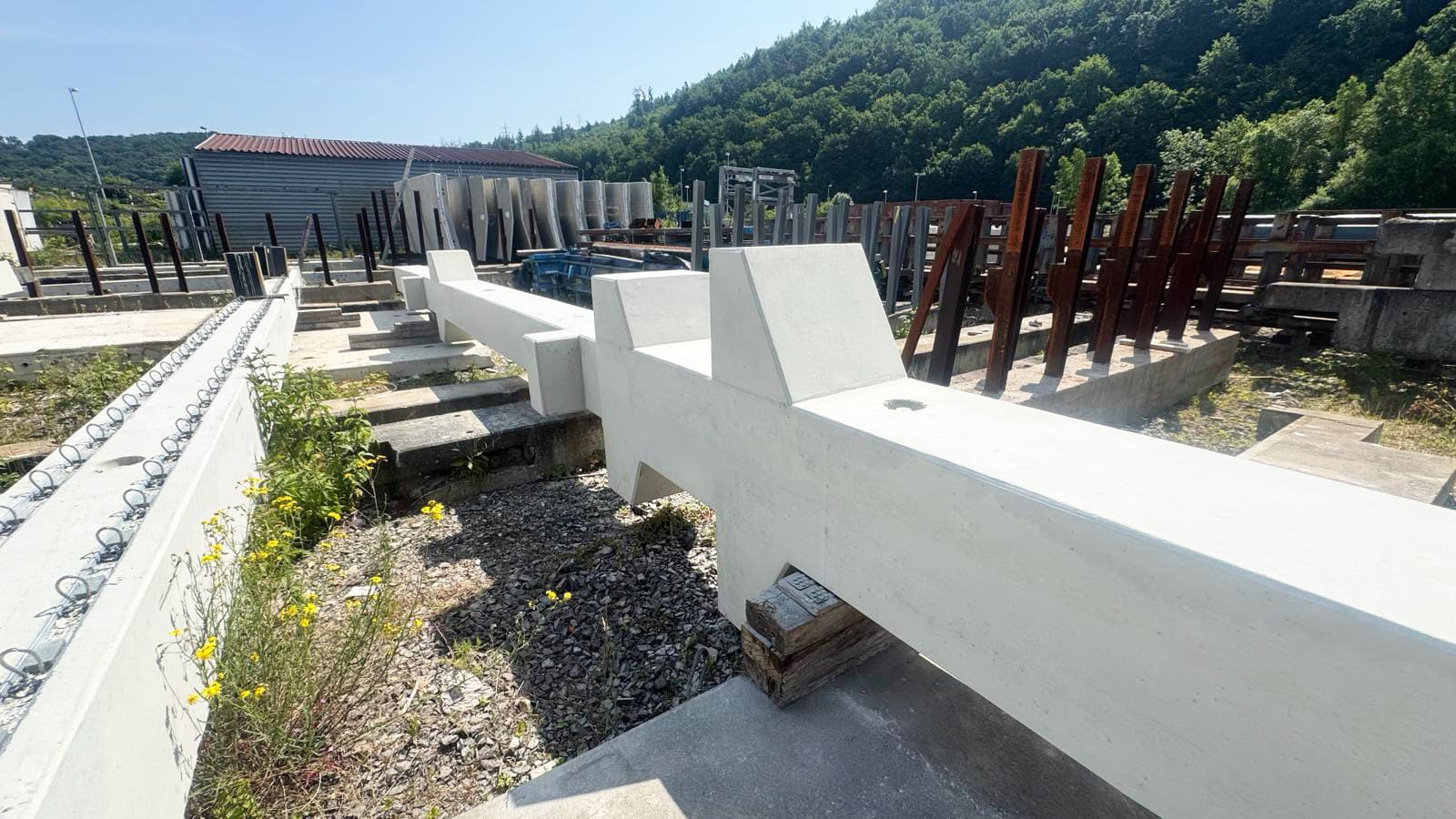
The system is designed to manufacture three precast concrete element types, identified as Timpan T1, T2 and T3. All three share a similar cross-sectional geometry, while differing mainly in overall length and in the longitudinal position of the integrated openings.
The T1 configuration is designed for elements measuring 1.48 m in length, with an approximate height of 0.483 m, an upper width of 0.30 m and a base width of 0.50 m.
The T2 configuration increases the production length to 2.40 m, with an approximate height of 0.50 m, while maintaining the same 0.30 m upper width and 0.50 m base width.
The T3 configuration allows the production of elements up to 3.50 m long, with an approximate height of 0.521 m, again maintaining an upper width of 0.30 m and a base width of 0.50 m.
The three geometries also incorporate defined chamfers of 20 × 45° and 30 × 45°, contributing to the final shape of the edges and transitions of the precast element.
Each piece also includes two circular openings arranged longitudinally, with diameter references of 0.05 m and 0.07 m. Their position varies according to the element length: in the T1 configuration they are located 0.45 m from each end, with 0.58 m between centres; in the T2 version, 0.70 m from each end and 1.00 m between centres; and in the T3 version, 0.75 m from each end and 2.00 m between centres.
This dimensional range allows different production requirements to be covered within the same family of precast elements while maintaining a common section and a consistent industrial process.
Robust structure and controlled opening sequence
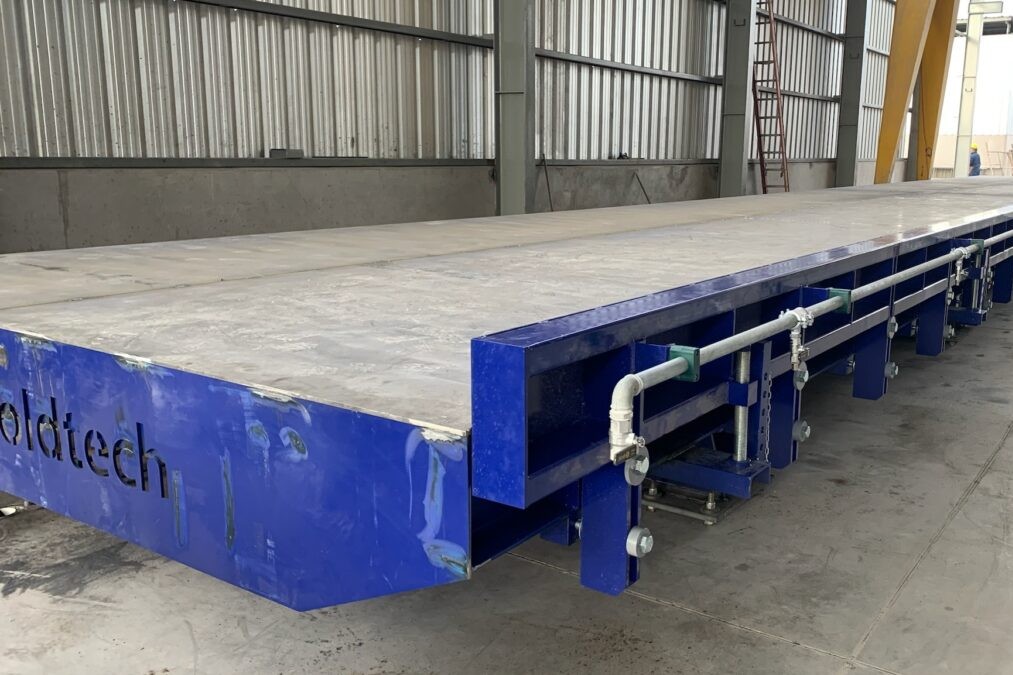
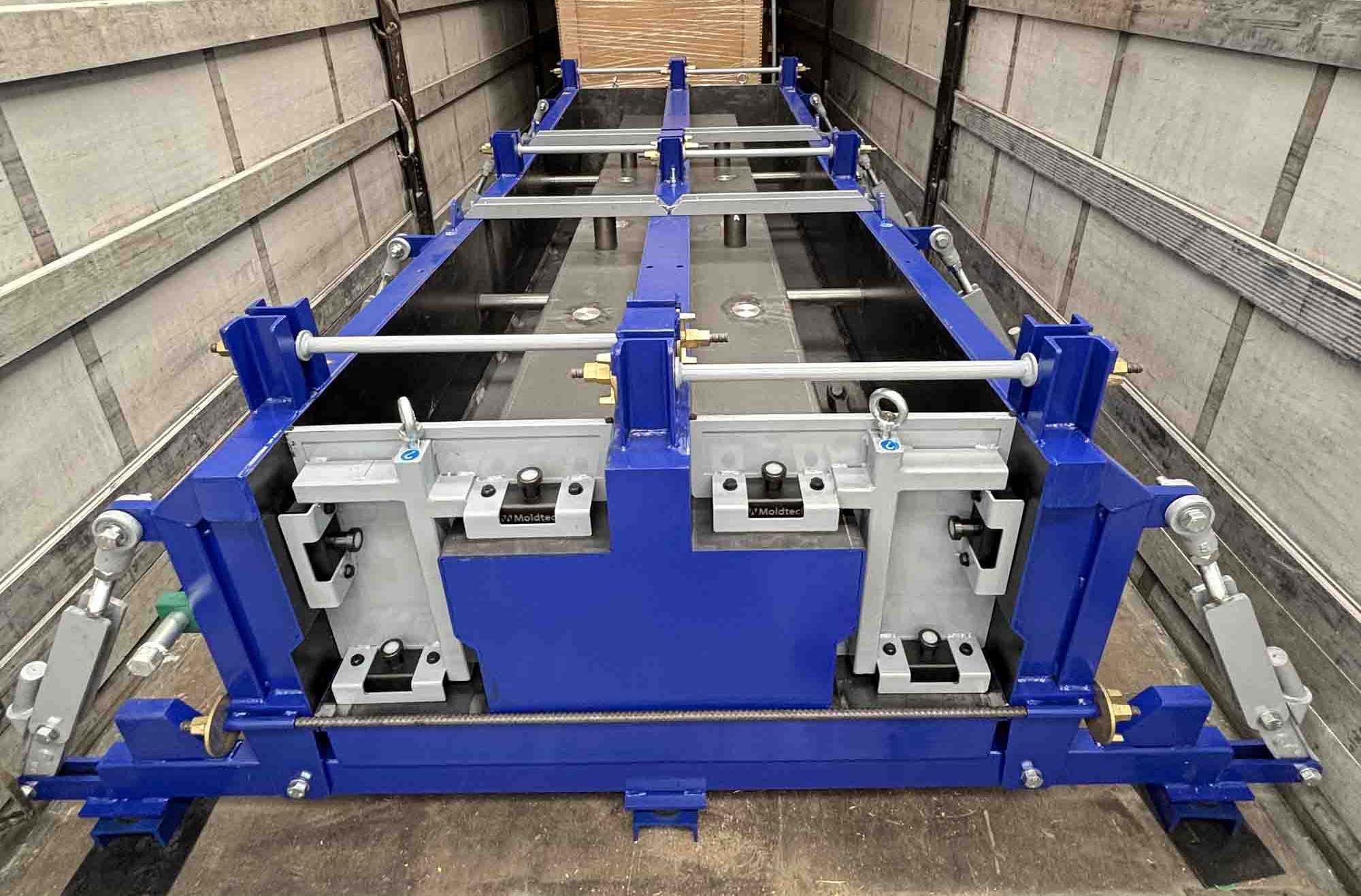
The Inverted Timpan Mould consists of two movable side panels, a base-bottom section, end shutters and a series of joining, opening, closing and fixing elements.
Its main components include movable panels, the base-bottom structure, simple end shutters, anchoring assemblies, side ties, upper locking systems and pneumatic vibrators.
This arrangement allows the mould to be progressively released during demoulding and facilitates the handling of the different components involved in the production cycle.
The opening sequence has been designed to support an orderly and controlled operation. Once the upper locking elements have been released, the movable side panels can be opened using the lateral tie system, while the end shutters can subsequently be removed using the corresponding fixing and handling systems.
Magnetic fixing for greater flexibility in mould setup
One of the main technical features of the system is the use of magnets with a holding capacity of 450 kg, used to secure the upper magnetic formwork and transverse separators.
These supports combine an integrated magnetic fixing system with threaded connections, allowing specific mould components to be positioned accurately while also facilitating removal or repositioning when required by the production process.
The equipment also includes dedicated tools for magnet release, together with lifting rings, side ties, spacer tubes, nuts, bolts and other accessories intended to simplify preparation and demoulding operations.
Pneumatic vibration for concrete compaction
The Inverted Timpan Mould incorporates a pneumatic vibration system designed to improve concrete flow and support proper compaction during filling.
The installation includes two HFP 1400C pneumatic vibrators, each with a centrifugal force of 1,453 kg and a frequency of 16,000 vibrations per minute.
The vibrators can be activated individually, allowing their operation to be adjusted to the specific requirements of the production cycle. The system is connected to an external compressed-air installation and is designed to operate under controlled pressure, filtration and lubrication conditions.
Vibration is activated once concrete pouring has started, helping distribute the mix correctly throughout the mould and contributing to a more homogeneous finished element.
A demoulding process designed for plant operation
The mould configuration enables a progressive demoulding sequence, making it possible to release the different structural elements before removing the finished precast piece.
The process includes releasing the upper locking systems, opening the movable side panels, removing the end shutters and extracting the internal elements used to form specific features in the precast unit.
The system also integrates steel pins associated with PVC tubes that remain incorporated in the finished element after the pins are removed. This solution makes it possible to form specific openings accurately without compromising the geometry of the element during demoulding.
Once the mould has been fully released, the finished piece can be removed using suitable lifting and handling equipment and transferred to the next stage of production.
Industrial production with controlled cycle repeatability
The equipment is intended for the manufacture of non-prestressed concrete elements and has been conceived for repetitive industrial production.
Before pouring, the mould surface is cleaned and prepared with a suitable release agent. The concrete is then placed, vibrated and levelled.
Once the material has reached the appropriate condition for handling, the mould opening sequence begins and the precast element is removed. After demoulding, the relevant components are cleaned and prepared for the next production cycle.
This sequence supports a stable working method focused on dimensional control, repeatability and proper maintenance of the moulding surfaces.
Installation designed for operational stability
The stability of the equipment is another key aspect of the project. The Inverted Timpan Mould must be installed on a surface with sufficient load-bearing capacity to support both the equipment and the precast element being produced.
The installation requires a maximum levelling deviation of ±0.005 m and includes the use of grout beneath the anchoring plates. This contributes to improved load transfer, reduced vibration and greater structural stability during operation.
This is especially relevant for equipment subjected to repeated vibration cycles, where correct levelling and anchoring have a direct impact on dimensional accuracy and the mechanical behaviour of the mould.
Maintenance focused on reliability and service life
Preventive maintenance includes regular removal of concrete residues, lubrication of moving parts, inspection of bolted connections, checking of welded joints and control of pneumatic components.
The vibration system also requires periodic inspection of hoses, connections, mechanical fixing points and vibrator lubrication.
These procedures help preserve the mechanical condition of the equipment and maintain reliable performance throughout its service life.
Industrial value of the supply
The project brings together several key requirements in the design of moulds for special precast elements: structural robustness, dimensional accuracy, operational simplicity, adaptability and repeatability.
Magnetic fixing simplifies selected setup and release operations, while pneumatic vibration supports the compaction and flow of the concrete during filling.
The ability to produce three different piece types, with lengths ranging from 1.48 to 3.50 m, increases the versatility of the system while maintaining a common cross-sectional geometry and a consistent manufacturing process.
This approach reflects Moldtech’s engineering philosophy: designing each Inverted Timpan Mould around the final precast element and the real production conditions of the plant, integrating precision, mechanical strength and ease of operation into a single industrial solution.
Moldtech and its international experience
With this project in Romania, Moldtech continues to expand its international activity as a manufacturer of moulds and equipment for the precast concrete industry.
From Spain, the company develops custom-engineered solutions for precast plants, adapting each design to the geometry of the elements, the required production process and the actual operating conditions of each project.
The T1, T2 and T3 Inverted Timpan Mould is another example of this approach: engineering applied to a specific production need, dedicated structural design and the integration of mechanical and pneumatic systems into equipment conceived for repetitive and reliable industrial use.