



In the realm of civil engineering and infrastructure construction, efficiency, durability, and speed of execution are paramount. Precast concrete box culverts are structural elements that meet these demands, offering a robust and versatile solution for a multitude of applications, primarily in drainage systems and underpasses.
These rectangular or square-section elements, manufactured in a controlled industrial environment, have proven to be a superior alternative to cast-in-place systems. In this article, we will analyze in detail what box culverts are, their advantages, and the manufacturing systems that Moldtech offers to produce them.
What is a Precast Concrete Box Culvert?
A box culvert is a reinforced concrete structure with a box-like shape, i.e., four-sided. They are manufactured as monolithic pieces or in two halves (articulated frames) that are assembled on-site. Their main function is to serve as a conduit for water flow in cross-drainage of roads and railways, but their use has extended to many other applications thanks to their high strength and modularity.
Prefabrication in a plant ensures that each piece meets strict standards of quality, strength, and dimensions, which is difficult to achieve with the same consistency in traditional on-site construction. This commitment to quality and innovation is what drives Moldtech into the future, as highlighted in recent industry news.
Key Advantages of Precast Box Culverts
The adoption of precast box culverts in infrastructure projects provides substantial benefits:
- Speed of Installation: Arriving on-site as a finished product, their installation is extremely fast. This minimizes traffic disruption in roadworks and significantly reduces project execution times.
- Guaranteed Quality and Durability: The industrial manufacturing process allows for exhaustive control over concrete dosage, reinforcement positioning, and the curing process. The result is a high-density, low-permeability product with a superior service life.
- Versatility of Applications: Their modular design and high load-bearing capacity make them ideal for drainage, underpasses for vehicles or pedestrians, service galleries, tunnels, and wildlife crossings.
- Cost Reduction: The speed of assembly reduces labor and site management costs. Furthermore, optimized factory production reduces material waste.
Moldtech Systems for Box Culvert Manufacturing
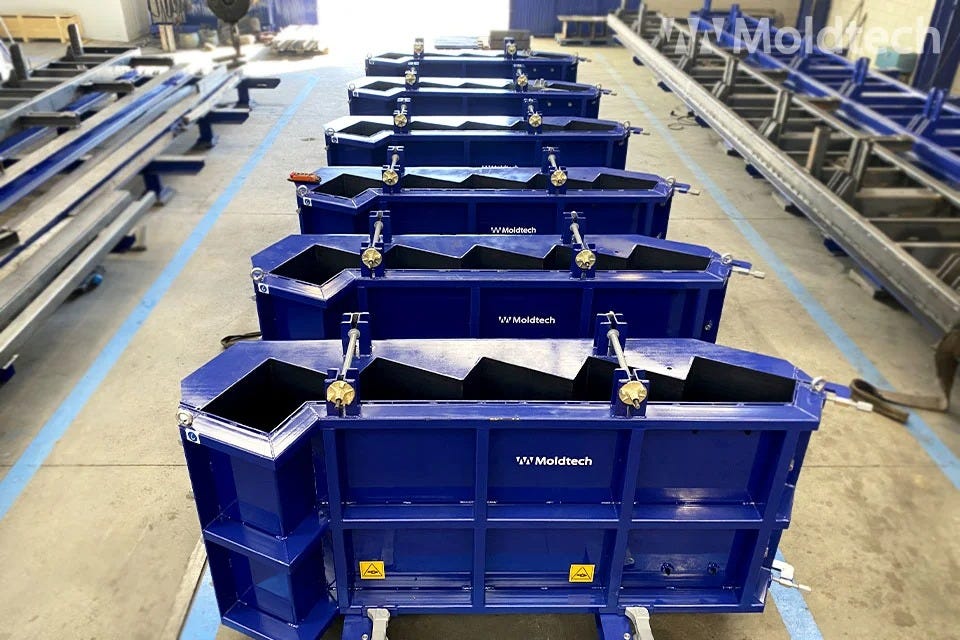
Moldtech has established itself as a leader in the design and manufacture of equipment for the production of box culverts, offering solutions adapted to different production needs and concrete types.
One of our flagship solutions is the MT-20 system, a high-productivity solution designed for manufacturing frames using vibro-compression of semi-dry concrete. This method allows for immediate demolding of the piece, which means that a single mold can produce a large number of frames per workday.
For projects requiring large or special-sized frames, Moldtech offers modular molds for wet-cast concrete. These molds are extremely versatile, allowing for the adjustment of both the width and height of the frame to be produced.
Main Applications of Precast Box Culverts
- Drainage and Sewerage: Their most common application, creating underground conduits for stormwater or wastewater.
- Underpasses: For the passage of vehicles, pedestrians, or wildlife under roads and railways, improving safety and connectivity.
- Service Galleries: Housing electricity, telecommunications, and water pipes, facilitating their maintenance.
Moldtech: Your Partner for Civil Works Production
The manufacture of elements for civil works requires robust, precise, and reliable equipment. Moldtech’s systems for box culverts are designed to maximize productivity and quality, adapting to the regulations and demands of each market.
With extensive experience in civil works projects worldwide, our technical team can advise you on the most cost-effective solution for your precast plant. If you are looking to optimize your production of box culverts, discover how our technology can boost your competitiveness.
