

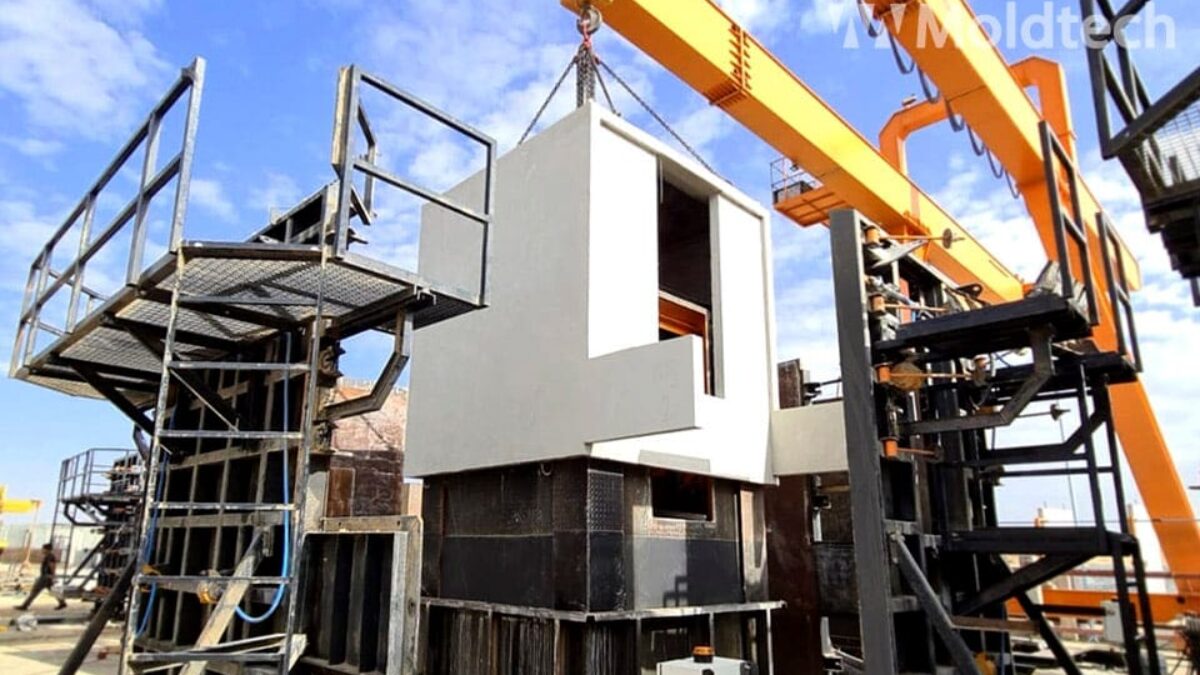
Off-Site construction: industrialising the way we build
Off-Site construction is much more than moving part of the work from the jobsite to a factory. When we combine Off-Site construction, precast concrete and modular building, we are talking about a strategic shift in how projects are designed, costed and delivered.
From our perspective at Moldtech, this approach is key for clients who need predictable deadlines, scalable production and strict quality control. We have seen it in residential, industrial and infrastructure projects in North America and Latin America: once a developer experiences a well-designed Off-Site workflow, it stops being “a trend” and becomes a new baseline for productivity and cost control.
What exactly is Off-Site construction?
When we talk about Off-Site construction or Off-Site manufacturing, we mean that a significant part of the building is designed, manufactured and preassembled in a precast factory environment, and later transported to site for final installation.
Unlike traditional in-situ construction, where everything depends on weather, site labour and on-the-spot decisions, industrialised construction relies on defined processes, standardised details and controlled curing and handling. It includes modular construction, 2D panels and 3D volumetric modules. Precast concrete fits naturally here: beams, columns, panels, stairs or full modules are produced in a precast plant with repeatable cycles, integrated logistics and quality protocols, not just “pieces poured somewhere off-site”.
Key economic advantages
Cost certainty and budget control from day one
One of the strongest arguments for Off-Site construction is cost predictability. In a factory, we can plan materials, cycle times and labour with far more accuracy than on an open jobsite. That translates into fewer budget deviations and fewer claims between owners, contractors and subcontractors.
In our turnkey projects for precast plants, clients repeatedly tell us the same thing: once the production line is stabilised, the unit cost per element is much easier to forecast than with traditional in-situ casting. In the United States, for example, in our project for Equipment for residential buildings and PBU moulds, the client’s financial team valued not only the productivity of volumetric modules, but the ability to lock in production costs for the whole residential program from the very start.
Faster project delivery and earlier revenue
Another clear advantage is time. With Off-Site construction, civil works and module or panel production run in parallel. While foundations and utilities are executed on site, the precast concrete elements are already being manufactured in the plant.
This overlap can shave months off the schedule. And that has a direct economic impact: the building starts generating rent, sales revenue or operational savings sooner. We learned this very clearly in the U.S. with our 3D moulds for modules of different sizes. The developer needed volumetric units to be ready as soon as the structure allowed installation. The Off-Site strategy, supported by flexible moulds, made it possible to reach the market earlier in a highly competitive residential segment.
Lower labour and rework costs
Labour and rework are silent cost killers. On-site, variability is high: changing crews, weather, access issues, and coordination with other trades. In a precast factory, we standardise tasks, repeat the same operations and reduce human error. Less rebar fixing in the rain, fewer improvised formworks, fewer tolerances out of spec.
From our experience, the biggest saving comes when the project is designed early for prefabrication (DfMA). When this does not happen, we often see expensive redesigns or complex custom adaptations in the plant. In our 3D bathroom pod mould project in Miami, the client initially wanted to replicate a traditional in-situ bathroom. What we did instead was help them simplify and standardise the geometry and the integration of MEP. The result: fewer adjustments on site, faster installation and significantly lower rework costs on every floor.
Why Off-Site construction fits perfectly with precast concrete technology
Off-Site construction and precast concrete technology are naturally aligned. Precast offers dimensional accuracy, durability and repeatability, which are exactly what an industrialised building system needs.
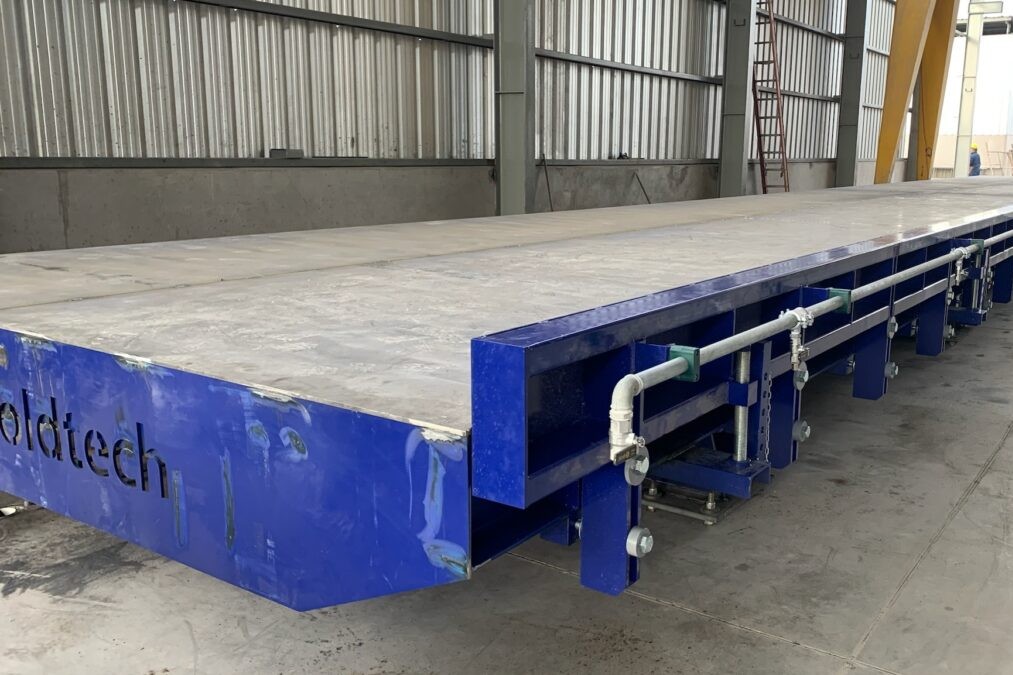
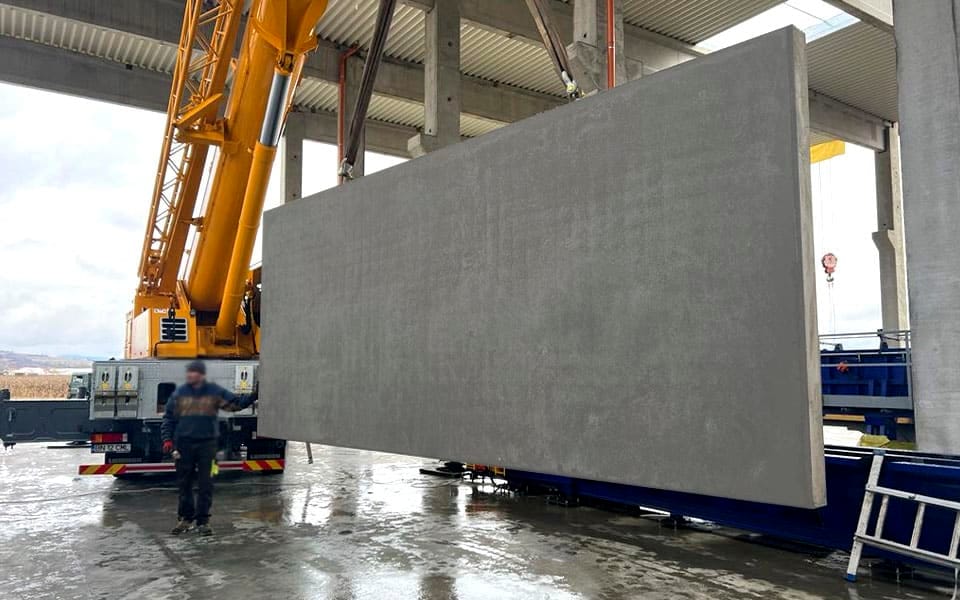
In Canada and Mexico, for instance, we have supplied tilting tables for wall panels in industrial buildings, as well as self-supporting fixed beds for prestressed panels. These solutions allow clients to produce large facade and structural elements with consistent quality and quick cycles. When we design the right moulds and handling equipment, we help them transform isolated precast elements into modular concrete structures that can be installed on site almost like a kit of parts. That is where the real economic advantage appears: high-quality repetition with minimal variation.
How Moldtech supports projects worldwide
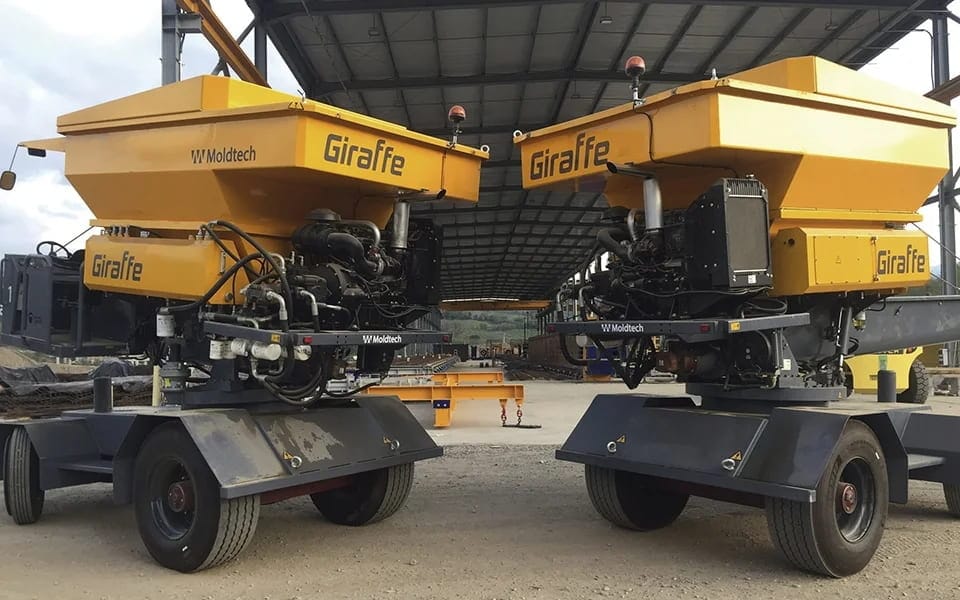
Our role at Moldtech is to act as a technological partner for companies that want to implement or upgrade Off-Site strategies. We design and manufacture precast concrete equipment, customised moulds and turnkey precast plants adapted to each business model.
In North America alone, we have provided tilting tables with hydraulic power units in Canada, prestressing systems for slabs in the United States, volumetric 3D moulds and 180º tilting equipment in Canada for safe handling of heavy elements. These are not isolated machines; they are parts of integrated modular construction solutions. From our experience, the key is to adapt the plant layout, automation level and mould versatility to the real production needs of the developer or contractor. When this alignment is done well, the return on investment improves sharply, even in demanding markets with high labour costs and tight schedules.
Making the business case for Off-Site construction in your next project
Verás, cuando analizamos proyectos recientes, una idea se repite: Off-Site construction reduces risk, compresses schedules and stabilises total project cost, especially when combined with well-designed precast technology. But none of this happens by chance. It requires a partner who understands both engineering and industrial production.
If you are evaluating Off-Site construction or planning a new precast facility, we can help you define the right moulds, equipment and plant layout to maximise your economic return. You can explore in more detail our projects, such as the 3D moulds for bathroom units in Miami or the tilting tables for industrial buildings in Mexico, and contact our team to review your specific needs or projects under study.