

Why sustainability in precast concrete matters today
The environmental benefits of precast concrete go far beyond a marketing claim. Today, our clients face growing pressure to cut CO₂, reduce waste and prove resource efficiency in every new tender. Traditional on-site casting, with variable quality and uncontrolled waste, simply doesn’t fit that picture anymore. Industrialised precast production, on the other hand, allows traceability, optimisation and real data for ESG reporting and life-cycle analysis.
This article explains in a practical way how precast concrete can improve the environmental performance of your projects, and how Moldtech helps turn this into reality through actual plants and equipment.
Key environmental benefits of precast concrete at a glance
In short, these are the main environmental benefits of precast concrete we see in real plants:
- Less concrete and steel waste thanks to controlled production
- Lower embodied CO₂ with optimised sections and improved mixes
- More efficient, concentrated energy use
- Greater durability and better thermal performance in service
- More options for reuse, disassembly, and recycling within a circular economy
The next sections explore each point in detail, with real-world project examples.
Environmental Benefits of Precast Concrete: Less Waste, More Efficiency
A common misconception is that excess concrete can always be reused elsewhere. In reality, on-site, much of that material is lost. In a well-designed precast plant, that changes entirely.
Controlled production that minimises waste
In an industrial environment, precast concrete sustainability starts with control: standardised moulds, precise dosing, repeatable geometries, and tight tolerances. This form of sustainable precast production minimises excess cuts, out-of-spec pieces, and reworking—frequent issues with in situ casting.
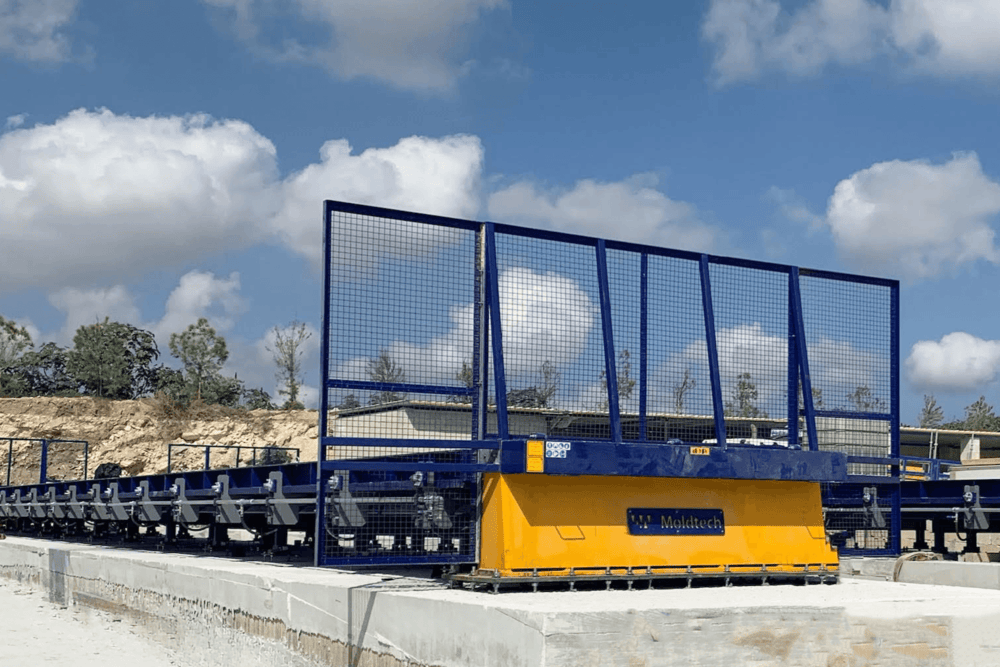
For example, in the Tilt Tables for Industrial Building Panels in Mexico, switching from on-site panels to large-format tilting tables allowed the client to standardise thicknesses and lengths. This drastically reduced the volume of offcuts and rejected pieces.
Our experience reducing waste with customised moulds
At Moldtech, when we design a 60 x 4 m tilting table or a 35 x 4.4 m tilt table for cladding panels, our goal is not just serial production, but also flexibility. Clients can adjust lengths and thicknesses without needing different equipment. This reduces the need for extra moulds, simplifies formwork adjustments and cuts raw material waste.
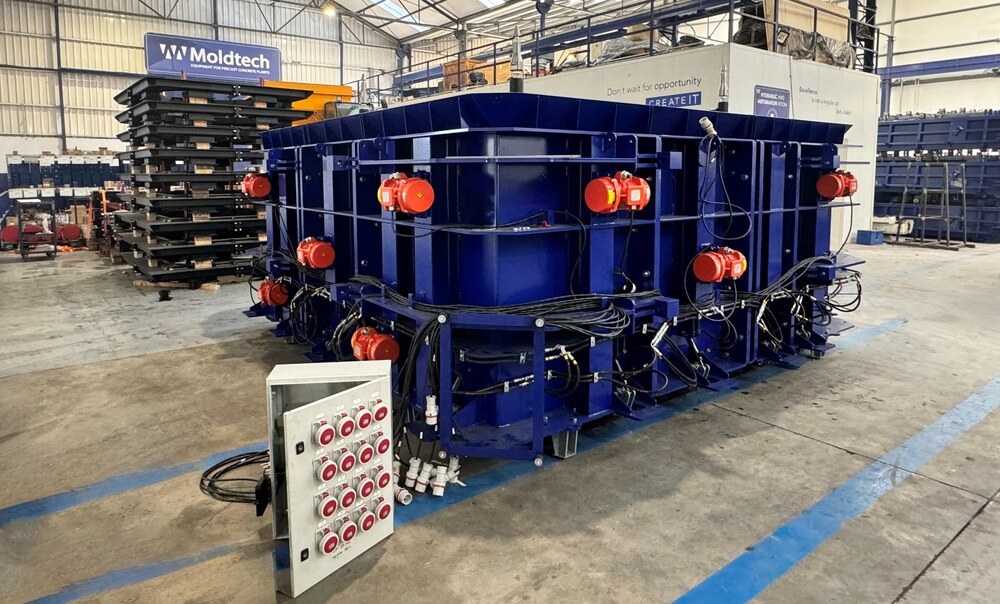
Similarly, the 3D Molds for Bathroom Units in Miami use a single modular system to produce different PBU models using the same frame, maximising mould cycles and avoiding the need to build new sets for each variant.
Lower carbon footprint and optimised mix designs
CO₂ discussions often focus on cement, but the true story of low-carbon precast concrete involves geometry, prestressing, mix design, curing, and service life. Precast allows comprehensive optimisation.
How precast contributes to lower embodied CO₂
The embodied CO₂ of a structural system depends on both material volumes and manufacturing methods. With precast concrete, you can:
- Design optimised sections, less concrete for the same structural performance
- Use prestressing to lighten elements
- Apply industrial curing to achieve performance with lower cement content
Projects like the Prestressing System for Slabs in the United States or the TT Slab Mold in Canada reduced slab depth and weight through prestressing and TT sections. This clearly decreased CO₂ per usable m² without sacrificing strength or span.
Mix innovation: from SCMs to high-performance elements
Precast plants are ideal for incorporating supplementary cementitious materials (fly ash, slag, limestone filler, etc.), reinforcing the environmental benefits of precast concrete. It’s difficult to control dosing, curing, and temperature on-site, but in plants equipped like those with a Fixed Self-Supporting Table for Prestressed Panels in Canada, process control enables lower clinker mixes and high early strength.
Longer-lasting and more durable elements improve life-cycle assessments, even when the initial cement impact remains significant.
Energy efficiency and factory-controlled processes
Energy in construction is like noise: the more scattered, the harder it is to manage. Factory production concentrates and optimises energy use, unlike dozens of disparate sites with random vibrators, generators, and makeshift curing.
Concentrated, optimised energy consumption
Energy efficient precast plants use centralised curing systems, automated mould handling and increasing heat recovery. This lets you truly measure kWh per unit and optimise with real data.
An example is the Tilt Table and Hydraulic Power Pack project in Canada. By integrating the table and a hydraulics unit in one system, the client cut cycle times, energy use per panel, and reduced defect rates that would otherwise require repairs or scrap.
What we would do differently in new plants today
Designing a plant from scratch today, we’d integrate energy monitoring from day one, insulate curing chambers, and use renewables (solar, biomass) as thermal sources from the start. It’s far easier and cheaper at design stage than retrofitting later.
Durability, thermal performance and life-cycle impact
It’s not just about how an element is made, it’s about how long it lasts. Here, well-made precast elements make a huge difference.
Long service life and reduced maintenance
High density, proper vibration and correct reinforcement protection deliver highly durable elements. In terms of life cycle assessment of precast concrete, this means fewer interventions, replacements, and emissions from repairs over the decades.
Moulds such as the Sewer Mold for Canada, used for buried infrastructure, are developed with joint and cover details that maximise service cycles, minimise early replacement, and cut cumulative impacts.
Better envelopes for energy-efficient buildings
Prefabricated façade panels and sandwich walls with integrated insulation outperform many traditional envelope systems thermally, reducing a building’s operational energy—often the biggest life-cycle factor.
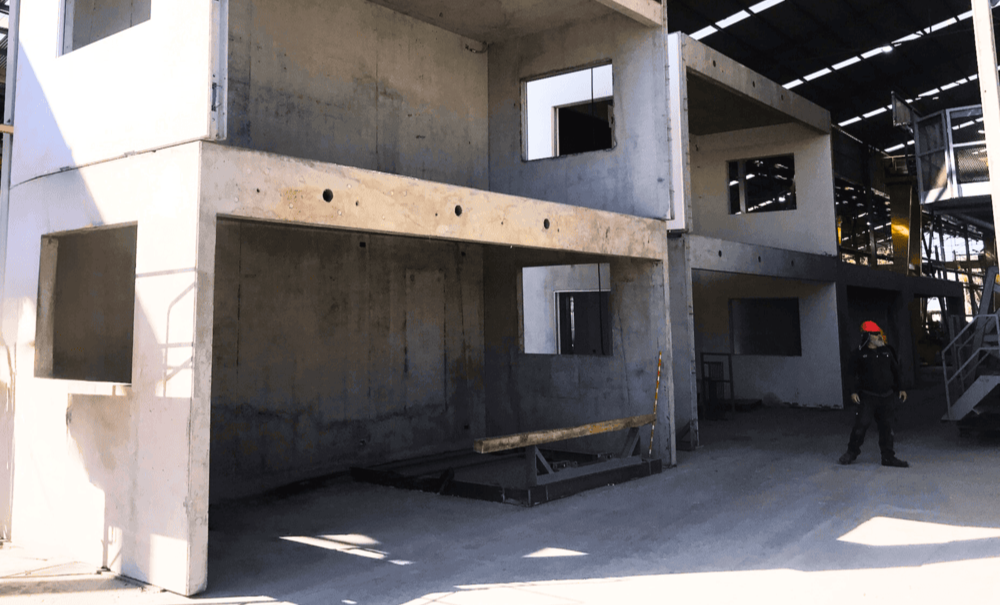
Projects like the Residential Building Equipment and PBU Molds in the United States combine structural precast panels with 3D modules to produce façades with tightly controlled thermal bridging and joints, directly impacting a building’s heating and cooling needs.
Environmental Benefits of Precast Concrete and the Circular Economy
Circular economy is more than recycling end-of-life concrete—it begins with systems designed for disassembly, reuse, and reconfiguration from the outset.
Reuse, disassembly and recyclability
Modular precast systems facilitate disassembly and relocation of whole elements. Steel reinforcement is easily recycled, and crushed concrete can be reused as aggregate for sub-base, fills, or even new mixes (subject to local regulations). This is how the circular economy in precast concrete becomes tangible.
The 3D Molds for Modules of Different Sizes in the United States, for instance, allow modules to be reconfigured or relocated, extending their usefulness beyond the original project.
How Moldtech equipment supports greener workflows
Clients are increasingly seeking systems that protect both the element and the mould. Equipment like the 180º 50 t Tilting Machine in Canada enables demoulding without damage, avoiding the need to re-cast full panels. Our modular moulds, such as those for PBUs and panels, can adapt to various sizes with the same frame, cutting down on the need for new moulds—and the associated steel, machining, and transport impact.
Aligning with green building standards and project requirements
Government clients, major developers, and investment funds are demanding more environmental data: product declarations, EPDs, LEED or BREEAM contributions, and more. The environmental benefits of precast concrete translate into points for materials, energy and waste categories.
Our experience in over 60 countries requires us to constantly adapt plants and equipment to different regulatory frameworks, integrating certification requirements from the turnkey project’s design phase onward.
How Moldtech helps you unlock the environmental value of precast
All these environmental advantages depend on plant, mould and automation design. This is where we add value.
At Moldtech, we design customised moulds and equipment to optimise material use, as in the various Tilt Tables in Mexico and Canada. We develop turnkey plants focused on energy efficiency and production traceability, and guide our clients through engineering and consultancy to align with sustainability targets globally.
With experience in over 60 countries, we know tailored solutions, not generic formulas, deliver real performance.
Turning sustainability into a competitive advantage
Ultimately, sustainability in precast is not just a compliance issue; it is a real business lever. Less waste, lower carbon footprint, efficient processes, long service life, and practical circularity drive better margins, higher scores in tenders, and a brand image aligned with today’s demands.
If you are looking to reduce the environmental footprint of your precast production, or planning a new plant, we can help you design moulds, equipment, and processes to realistically and profitably achieve your goals.